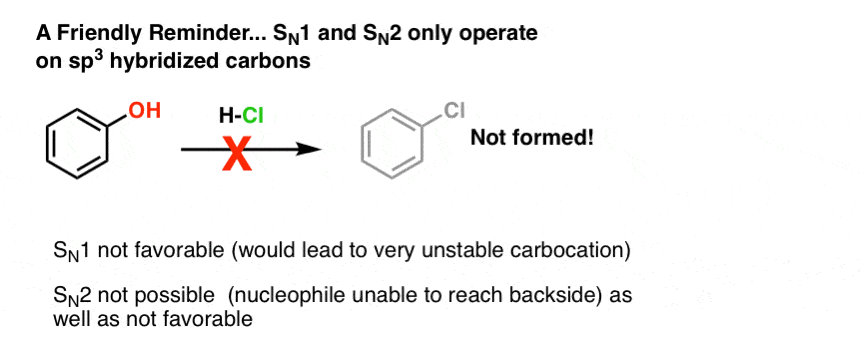
The student asked why do vinyl halides not do the sn2 reaction my answer was that two reasons exist for why the vinyl halide will not react with a nucleophile.
Could sn1 act on a vinylic carbon.
So let s draw this in.
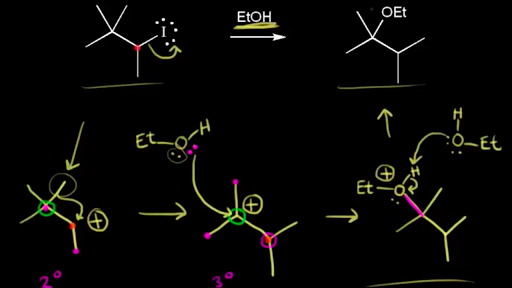
The carbon in red is directly bonded to two other carbons so this is a secondary carbocation.
So in an sn1 type mechanism your first step is dissociation.
So you re going to get these electrons in here kicking off onto your halogen onto your bromine to form your bromide anion.
Another important difference between allylic and vinylic carbon is that allylic carbon is sp 3 hybridized where vinylic carbon is sp 2 hybridized.
And we know in an sn1 type mechanism let me go ahead and just write that here.
If you look at the michael addition reaction the 1 4 addition of a nucleophile to the carbon carbon double bond in an ce alpha beta unsaturated carbonyl system this could be viewed as an ce s n 2 attack on a carbon carbon double bond but again it is favored lower in energy because you create an intermediate with a negative.
If you think about the video on carbocations and rearrangements.
Or the carbon atom with sp hybridization is said to be vinylic carbon.
Today i got a good question i want to make a point of posting the best question from the day s teaching and my answer.
Lewis structure of vinyl chloride a vinyl ic halide.
So you could think about an sn1 type of mechanism.
If we look at this carbocation it is secondary.
We are gonna form a carbocation and the carbon in red is this carbon so this carbon gets a plus one formal charge.
The carbon atoms directly attached to the multiple bond double or triple bond is said to be vinylic carbon.
This molecule has four vinyl ic positions each marked with.
Allylic carbon indirectly relates to a double bond whereas vinylic carbon is directly involved in a double bond.
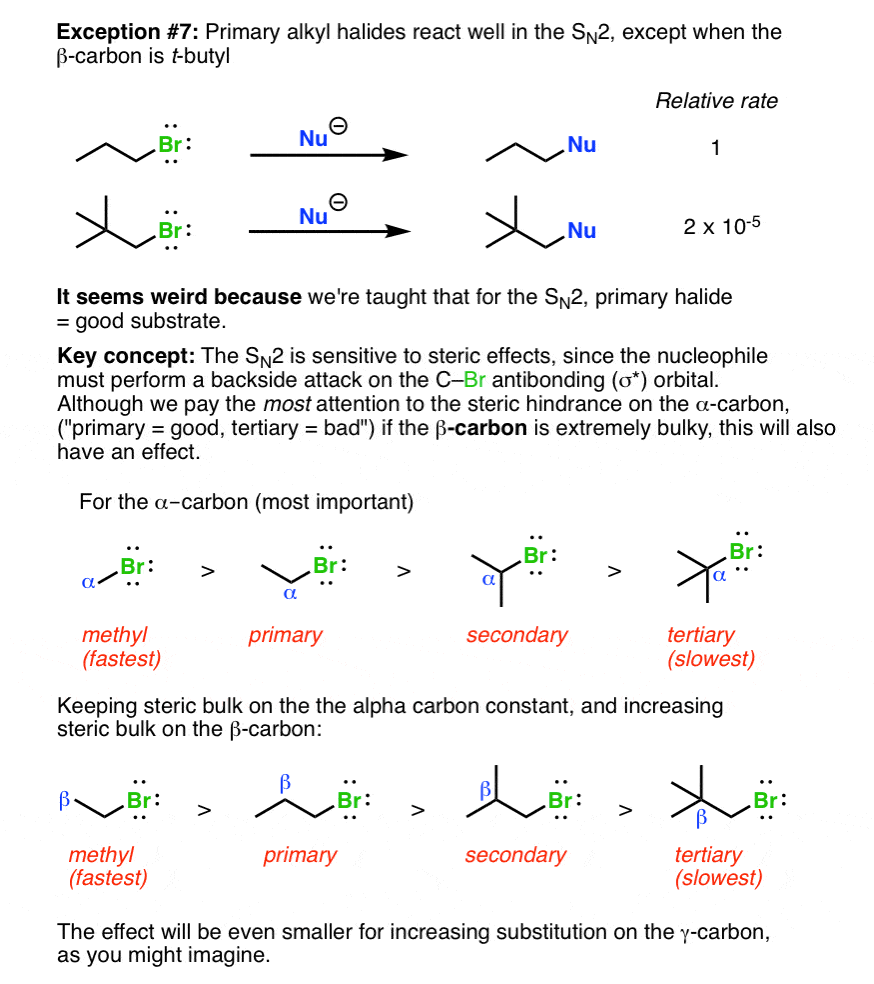
Both aryl and vinylic halides are relatively unreactive in s n 2 displacement mechanisms mostly because during the backside attack of the molecule the incoming nucleophile is sterically hindered by both substituents and electron density from any double bonds present.
On or bonded to the carbon of an alkene.
In solution nucleophilic vinylic substitution reactions involving electron withdrawing groups on the carbon carbon double bond e g cn cho and no 2 would almost certainly proceed via a.
B the curved arrow notation is shown in the following scheme.